Pain After Back Surgery
Persistent pain after spine surgery — sometimes called failed back surgery syndrome — is more common than many patients are told, and it is often treatable without another operation.
Our evaluation looks at every potential pain generator in and around the surgical site so the next step is informed rather than reflexive.
Diagnosis-first care for pain after back surgery
Physician-led evaluation, image-guided procedures when indicated, and insurance-friendly scheduling across three Houston-area clinics.
Understanding pain after back surgery
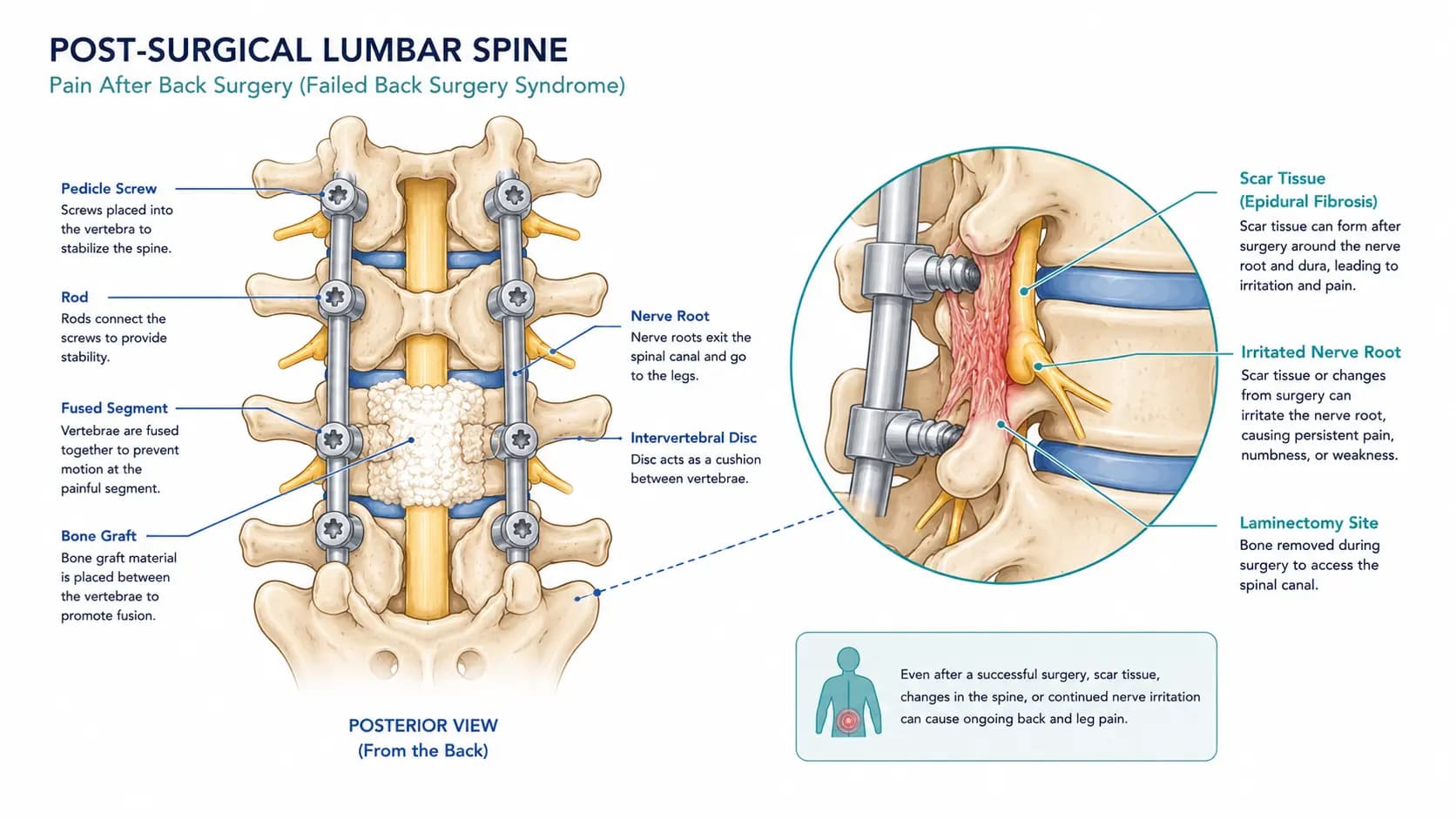
Pain after back surgery can come from many sources: incomplete decompression, scar tissue around a nerve root, adjacent-segment disease where vertebrae above or below the fusion are now overloaded, sacroiliac joint dysfunction, facet pain, or muscle deconditioning. The pattern often shifts from the original symptom, which is why a careful re-evaluation matters.
It is also common for patients to be told there is nothing more to do. That is rarely the full picture. Modern interventional pain care offers targeted, non-surgical options for many post-surgical patients, even when imaging is read as showing a successful operation.
Our goal is to identify each contributing pain generator and address them in the right order — often without proposing additional surgery.
Some post-surgical changes warrant urgent re-evaluation rather than continued conservative care.
- New or progressive weakness in a leg
- Loss of bowel or bladder control
- Wound drainage, redness, or fever
- Severe pain that is dramatically different from prior pattern
What patients usually describe
- Pain similar to before surgery that returned after a temporary improvement
- New pain in a different location, especially the buttock or hip
- Sharp pain with sitting, standing, or specific motions
- Numbness, tingling, or weakness in a leg
- Stiffness and difficulty bending
- Pain at the surgical level or above and below it
- Sleep disruption from positional pain
What we look for in evaluation
- Scar tissue around a previously decompressed nerve
- Adjacent-segment disease at levels next to a fusion
- Sacroiliac joint dysfunction unmasked after fusion
- Facet joint pain at unfused levels
- Muscle deconditioning and altered mechanics
- Hardware-related irritation in a small subset of patients
Diagnosis comes before any procedure.
We start by reviewing operative notes and prior imaging to understand exactly what was done and which structures remain. Examination then identifies the current pain generator, which is often different from the original. Diagnostic injections are particularly useful in this group to confirm contributors before committing to longer-term treatment.
Detailed surgical history, current exam, review of imaging.
Diagnostic blocks to confirm the active pain generators.
Sequenced plan that treats one source at a time.
Treatments we offer for pain after back surgery
Each option below is matched to a confirmed pain generator. We start with the least invasive effective approach and only escalate when the diagnosis supports it.
Your first appointment
Bring your operative notes and imaging if available. Plan for a longer first visit so we can map your full surgical and pain history before recommending any procedure.
What recovery typically looks like
Recovery in this group is incremental. Improvement usually comes from treating one contributor at a time and confirming response before moving to the next step.
Conditions patients with pain after back surgery often ask about
Questions about pain after back surgery
Does ongoing pain mean my surgery failed?
Not necessarily. Surgery often addresses one specific structure, and other pain generators can remain or develop later. Re-evaluation often reveals treatable causes.
Will I need another surgery?
Most patients in this group do well with non-surgical interventional care. Surgery is reserved for specific structural problems and is not the default next step.
How soon after surgery can I see you?
Once your surgeon clears you for outpatient care, we are happy to evaluate. Earlier evaluation often shortens the path to relief.
Ready to find the source of your pain?
Share a few details and our team will reach out to confirm a time that works with your schedule and your insurance.
Request an appointment
Tell us about your pain after back surgery symptoms and preferred clinic. We will confirm the next available appointment options.